
“¡Free: the 2-minute perimenopause symptom check. See which changes are likely hormonal. Take the check →”

What Is Perimenopause? A Plain-English Guide
Perimenopause is a normal stage of life, not an illness. But the hormone swings behind it can affect your periods, sleep, mood, weight and more.


What is perimenopause? It is the transition before menopause, when your ovaries start making less of the hormones estrogen and progesterone, and their levels rise and fall unevenly. It usually begins in your 40s, lasts about four years on average, and ends once you have gone 12 months in a row without a period. That point is menopause. (Cleveland Clinic)
Perimenopause is a normal stage of life, not an illness. But the hormone swings behind it can affect your periods, sleep, mood, weight and more. This guide explains what is actually happening in your body, how perimenopause differs from menopause, and what you can do about it.
Table of Contents
ToggleWhat is perimenopause, in simple terms?
“Peri” means “around” or “near”, so perimenopause means the time around menopause. Doctors also call it the menopausal transition. The US Office on Women’s Health describes it as “the time leading up to your last period”. (Office on Women’s Health)
Think of it as a gradual wind-down rather than a switch. Your periods do not stop overnight. Instead, your cycle starts to change, often over several years, until it stops for good.
What happens to your hormones in perimenopause?
Two hormones made by your ovaries matter most:
- Estrogen helps regulate your cycle and also affects your brain, bones, skin, heart, vagina and bladder.
- Progesterone prepares the lining of the uterus each cycle and has a calming effect.
In perimenopause, your ovaries begin producing less of these hormones. As estrogen decreases, it throws off the balance with progesterone. Cleveland Clinic says it is common for hormone levels to “go up and down like a rollercoaster” during this time. (Cleveland Clinic)
This is the key to understanding perimenopause. It is not a steady decline. Some months your estrogen may be high, other months low. That unpredictability explains why symptoms can come and go, and why one blood test can look normal. Mayo Clinic notes that many perimenopause symptoms are linked mainly to falling estrogen. (Mayo Clinic)
Perimenopause vs menopause vs postmenopause
These three words are often mixed up. Below is an illustration on how they differ.
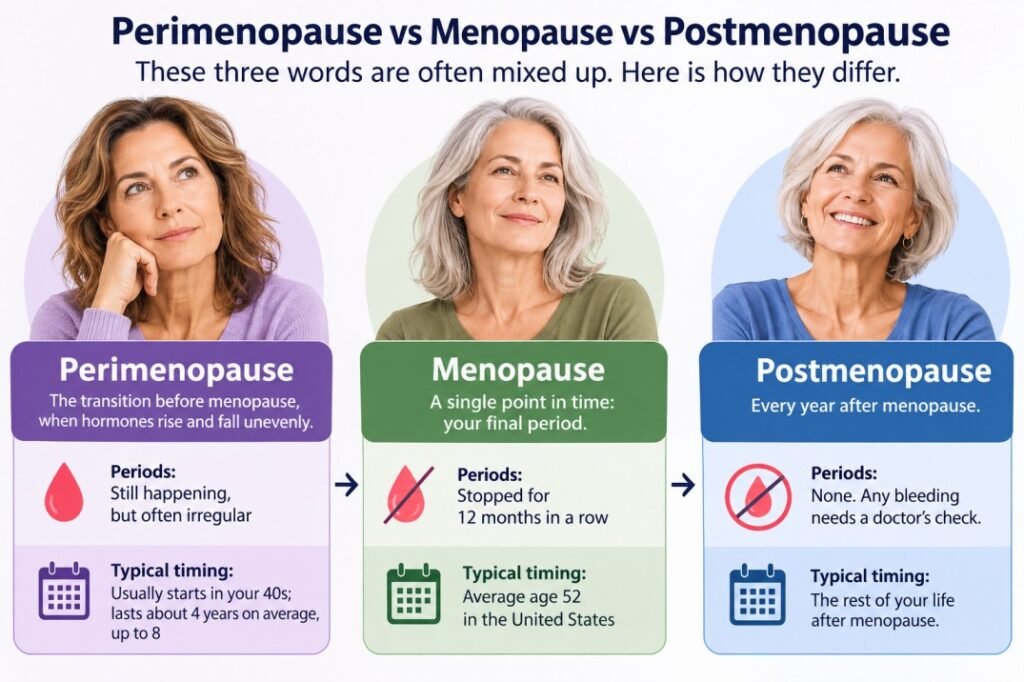
Sources: Cleveland Clinic; Office on Women’s Health.
In everyday speech, people often say “menopause” when they mean perimenopause. That is why so many women are surprised to have symptoms while they are still having periods.
When does perimenopause start?
Most women notice changes in their 40s. Cleveland Clinic says perimenopause may begin as early as your mid-30s or as late as your mid-50s, and typically starts about 8 to 10 years before menopause. (Cleveland Clinic)
Some things can make it start earlier, including smoking, a family history of early menopause, cancer treatment, a hysterectomy and some health conditions. (Mayo Clinic)
How long does perimenopause last?
The average length of perimenopause is about four years, but it can last up to eight. (Cleveland Clinic) The Office on Women’s Health puts the range at two to eight years before periods stop for good. (Office on Women’s Health)
Researchers split it into an early stage, when your cycle length starts to vary by 7 days or more, and a late stage, when you go 60 days or more between periods. (Harlow et al., Menopause, 2012) Read more in the stages of perimenopause, explained.
What is early or premature menopause?
Most women reach menopause in their early 50s, but not everyone. The Office on Women’s Health defines:
- Early menopause: menopause between ages 40 and 44
- Premature menopause: menopause before age 40, also called primary ovarian insufficiency (POI)
Causes include surgery to remove both ovaries, chemotherapy or pelvic radiation, smoking, genetic conditions and a family history of early menopause. Sometimes there is no clear cause. Because years without estrogen raise the risk of bone loss, heart disease and diabetes, early menopause is worth discussing with a doctor. (Office on Women’s Health)
If your periods become irregular or stop before 40, see a doctor to find out why.
What does perimenopause feel like?
It feels different for every woman. The most common changes are:
- Irregular periods: closer together, further apart, heavier or lighter
- Hot flashes and night sweats
- Poor sleep and fatigue
- Mood changes, irritability and anxiety
- Brain fog
- Weight gain around the middle
- Aching joints
- Vaginal dryness and lower sex drive
For the full list, read perimenopause symptoms: the complete guide or print the perimenopause symptoms checklist. To see which of your own changes match common patterns, take the free perimenopause symptom check.
Is perimenopause bad for your health?
Perimenopause itself is a natural process. But the drop in estrogen brings changes you cannot feel. Changing estrogen levels can raise cholesterol and increase the risk of heart disease and stroke, and bone loss can lead to osteoporosis. (Office on Women’s Health) Your 40s are a good time to check your blood pressure and cholesterol, stay active, and include strength training to protect your bones and muscles.
Can you get pregnant during perimenopause?
Yes. As long as you are still having periods, even irregular ones, pregnancy is possible. (Cleveland Clinic) If you do not want to get pregnant, keep using birth control until 12 months after your last period, or until your doctor says it is safe to stop.
How do you know if you are in perimenopause?
Usually from your age, symptoms and cycle changes, not from a test. Cleveland Clinic says hormone testing is not necessary to diagnose perimenopause, because hormone levels fluctuate too much for tests to be reliable. (Cleveland Clinic) UK guidance says perimenopause can be diagnosed in otherwise healthy women over 45 based on hot flashes and irregular periods, without lab tests. (NICE)
Read is there a test for perimenopause? for when tests do help
What helps with perimenopause?
Treatment depends on which symptoms bother you most. Options a doctor may discuss include:
- Hormone therapy: estrogen, or estrogen plus progesterone
- Birth control pills: to steady hormone levels
- Antidepressants: for hot flashes, mood changes, anxiety or depression
- Gabapentin or oxybutynin: medicines that can also relieve hot flashes
- A hormonal IUD: for irregular bleeding
- Vaginal creams and lubricants: for dryness and painful sex
- Lifestyle changes: diet, exercise, layered clothing and stress management
Source: Cleveland Clinic. Thinking about natural options? Read perimenopause supplements: what the evidence supports before you buy anything.
Perimenopause when you are raising kids
For many women, perimenopause arrives at the busiest point in life. Teenagers, younger children, work and ageing parents can all peak at once.

It is easy to put new symptoms down to stress or being a tired mom. Knowing what perimenopause is helps you name what is happening, and naming it is often the first step to getting help.
When should you see a doctor?
See a doctor if your symptoms are hard to live with or affect your quality of life. Do not wait if you have:
- Heavy bleeding with large clots
- Bleeding between periods or after sex
- Periods less than 21 days apart
- Any bleeding after 12 months without a period
- Periods that stop or become irregular before age 40
Frequently asked questions
What is perimenopause in simple terms?
Perimenopause is the transition before menopause, when your ovaries make less estrogen and progesterone and their levels rise and fall unevenly. It usually starts in your 40s and ends once you have gone 12 months in a row without a period.
What is the difference between perimenopause and menopause?
Perimenopause is the transition, when you still have periods but they often become irregular. Menopause is a single point in time: your final period, confirmed after 12 months with no period. The average age of menopause in the United States is 52.
At what age does perimenopause start?
Most women notice changes in their 40s. Perimenopause can begin as early as the mid-30s or as late as the mid-50s, and it typically starts about 8 to 10 years before menopause.
How long does perimenopause last?
Perimenopause lasts about four years on average, but it can last up to eight years. It ends 12 months after your final period.
What happens to your body during perimenopause?
Your ovaries produce less estrogen and progesterone, and levels swing up and down. This can cause irregular periods, hot flashes, poor sleep, mood changes, weight gain around the middle and vaginal dryness. Bone loss and cholesterol changes can also begin.
Is perimenopause the same as early menopause?
No. Perimenopause is the normal transition before menopause. Early menopause means reaching menopause between ages 40 and 44, and premature menopause means reaching it before age 40. See a doctor if your periods stop before 40.
Sources
- Cleveland Clinic. Perimenopause.
- US Office on Women’s Health. Menopause basics.
- US Office on Women’s Health. Early or premature menopause.
- Mayo Clinic. Perimenopause: symptoms and causes.
- Harlow SD, et al. Executive summary of the Stages of Reproductive Aging Workshop + 10. Menopause, 2012.
- NICE. Menopause: diagnosis and management (NG23), recommendations.
This article is for information only and is not medical advice. It cannot diagnose or treat any condition. Speak to a qualified health professional about your symptoms. MomBliss HQ may earn a commission from some links on this site, at no extra cost to you.